The Journey to Autonomous DLP · Context Intelligence
Understand the content and the boundary first. History is a secondary factor.
TL;DR: Effective DLP starts with understanding what the data contains, whose information it is, and whether its movement to the destination account is authorized. Accurate content and business context enable real-time protection while reducing unnecessary blocks and investigations. Lineage is secondary evidence—not a prerequisite for recognizing exposure or a substitute for understanding the content. Does the history change the decision—or merely make the explanation longer?
Our vision for Autonomous DLP starts with understanding data well enough to make the right decision in real time.
What does the document contain? Does it hold the user’s own information, someone else’s records, or confidential company material? Where is the data moving, and does the destination belong to the company, an approved partner, or an uncontrolled personal account?
When sensitive company information is about to cross a boundary without authorization, the system should recognize the exposure and stop the transfer in real time. When the activity reflects an unsafe habit, it should help correct it. When a sequence warrants an insider-risk investigation, it should connect the evidence and explain the concern.
That is the foundation we believe matters most: accurate content detection, meaningful context, and timely action. Lineage can enrich a decision or help reconstruct an incident, but a clear policy violation should not require tracing a document's entire history before stopping the transfer.
Useful does not mean necessary
My industry colleague, Nishant Doshi, CEO of Cyberhaven, recently wrote on LinkedIn about what it takes to build data lineage at enterprise scale. His post, reposted in Cyberhaven’s LinkedIn feed, points to the October 9 article, “Not All Lineage Is the Same”, which he coauthored with his colleagues. Their argument puts lineage at the center of understanding data: tracing its origins, transformations, and movement across people and applications to establish the context for protection.
We agree that context matters. Our disagreement is about which context is essential.
Cyberhaven emphasizes the history of the content. We prioritize what enables better decisions in real time: understanding what the content is, whose information it contains, and whether its movement is authorized.
Movement context is not content understanding
A document moved from Google Drive to Signal. That tells us the route. It does not tell us whether the document contains a public presentation, the employee’s own tax return, or an unreleased company financial report.
Those distinctions determine what needs protecting.
Accurate content detection identifies sensitive information. AI-powered document classification helps explain what the document is—a financial report, payroll file, customer list, source-code file, or personal document. Understanding whether the information is personal or work-related, whose data it contains, and whether the business permits its use adds the context needed for an informed decision.
Lineage can track copies, fragments, and transformations. But tracing those relationships does not, by itself, establish what the current content means or whether its use is permitted.
In its article on global versus local lineage, Cyberhaven frames content inspection largely through the limitations of pattern matching. That comparison leaves out the premise of AI-powered content understanding: interpreting documents, the relationships within them, and their business significance—not merely matching strings to patterns.
When detection relies on pattern matching, origin and history can become proxies for data sensitivity.
Lineage should not become a substitute for understanding the content.
The article’s own example describes an endpoint observing sensitive customer data being uploaded to a personal Dropbox account. If the content is accurately understood and that transfer violates policy, the essential evidence for prevention is already there. What additional history is necessary to stop it?
Same source. Different risks.
Google Drive holds confidential business plans alongside public presentations, lunch menus, employees' personal documents—such as stock option grants, tax returns, rental agreements, and vacation itineraries—and files approved for external sharing.
The same mix exists across SharePoint and internal repositories.
A file's presence in a corporate system does not establish its sensitivity or whether a particular transfer is authorized.
Consider two documents moving from the same company-managed folder to a personal account.
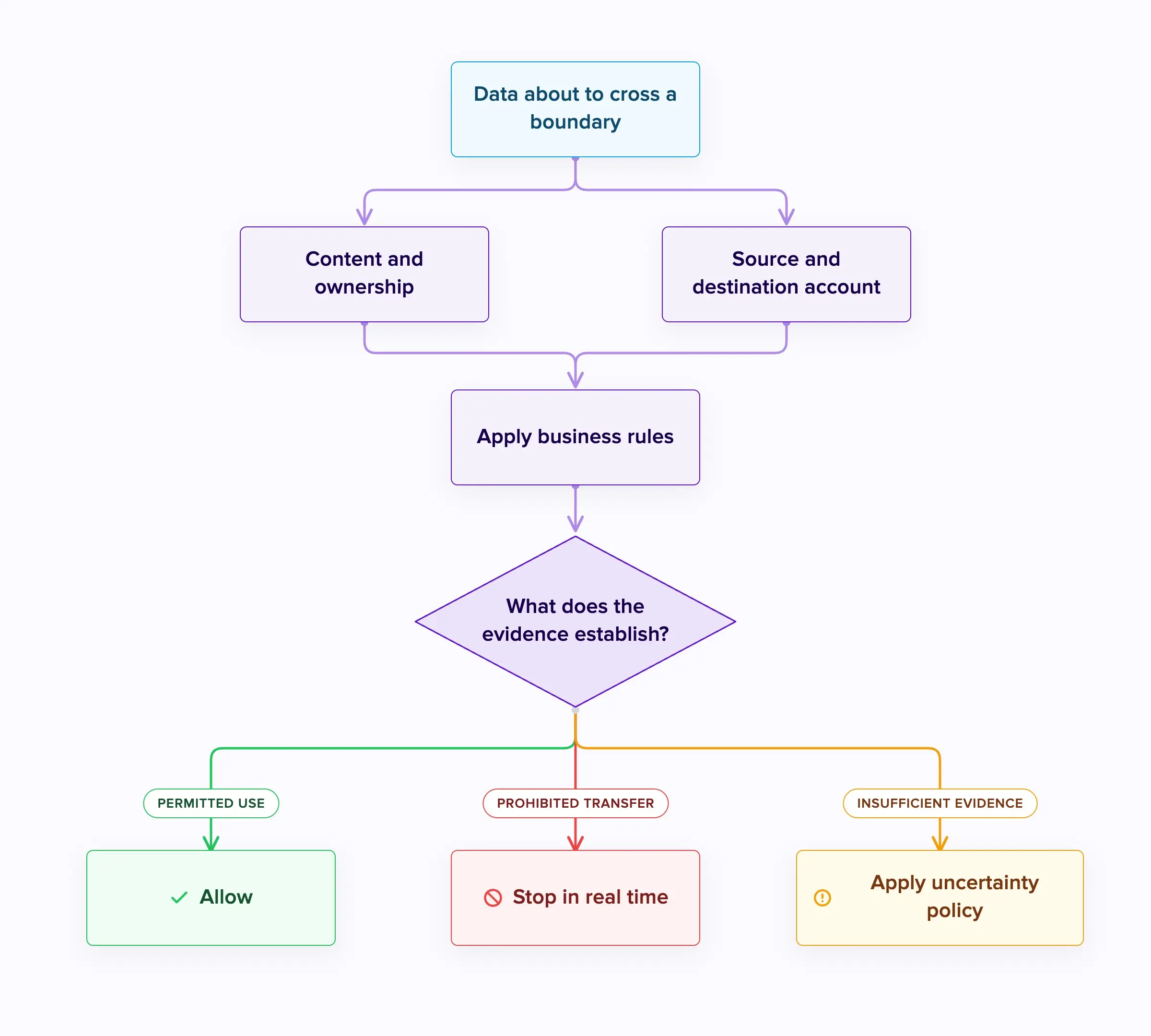
Illustrative policy choices. Both documents contain sensitive information; ownership and permitted use distinguish the response.
The source and destination look identical. The protection decisions should be different.
An origin-based judgment risks treating both documents alike. Accurate content and context explain why they differ.
The cost of misunderstanding is noise
When origin becomes a proxy for sensitivity, ordinary activity can look suspicious simply because a file came from a company system.
An employee handling their own tax return can become an unnecessary block, alert, or investigation.
The reverse is equally important: confidential company information may be copied into a personal document or pasted into a new application. Understanding its current content matters regardless of where it originated.
A longer history does not correct an inaccurate classification. It may simply give analysts more material to review.
The test is whether DLP catches real exposure while letting legitimate work proceed—not how much history it can reconstruct.
Content understanding survives changes in format
Copying a paragraph, taking a screenshot, or compressing a file changes how information is represented. It does not automatically change what the information means.
Nightfall can scan pasted text and screenshots. If someone pastes customer records into a personal AI account or uploads a screenshot of a confidential report, direct inspection may provide enough evidence to recognize the exposure without reconstructing the original file's complete history.
Some transformations make classification more difficult. Encryption can prevent content inspection, but the system can still recognize an encrypted file and apply the company's policy for unreadable content.
The principle remains the same: use the available evidence to understand the current risk.
Recognizing risk does not require every step in a file's life
Repeated uploads of protected customer information to personal accounts can reveal unsafe data-handling habits. A sudden transfer of confidential records to an unauthorized destination may warrant an insider-risk investigation.
Understanding these risks requires connecting relevant events with content, identity, destination, timing, and business context—not necessarily reconstructing the complete history of every document. Event correlation connects actions to reveal risky behavior. Comprehensive lineage reconstructs how the data originated and evolved. The former does not always require the latter. Both have value, but comprehensive lineage is not always necessary to recognize the risk.
And when a single event clearly establishes a prohibited transfer, DLP should stop it before the data leaves—not wait for a longer story.
Judge protection by the decision it makes
History belongs in the assessment when it changes the decision, clarifies earlier handling, or strengthens an investigation. But its existence does not make it the foundation of effective DLP.
The practical test is whether the system accurately identifies sensitive content, understands ownership and business use, recognizes the destination account, and acts before an unauthorized transfer completes—while allowing legitimate work to proceed.
The decision begins with the current data and the applicable rule. Prevention requires a supported enforcement point before the transfer completes.
Test these outcomes using both sensitive files and convincing negative examples: personal documents, confidential records, screenshots, pasted excerpts, encrypted files, and transfers between personal and company accounts.
Measure missed exposure, unnecessary blocks, and time to enforcement.
A sophisticated account of where data has been cannot compensate for misunderstanding what is leaving now.
Does the history change the decision—or merely make the explanation longer?


